
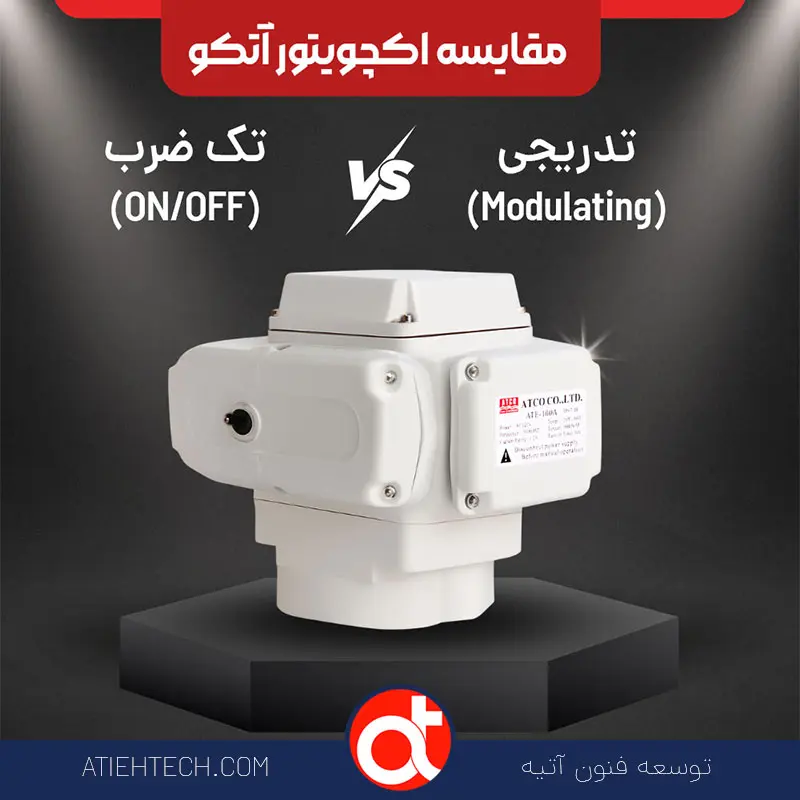
Difference Between Single-Action (ON/OFF) and Modulating ATCO Actuators
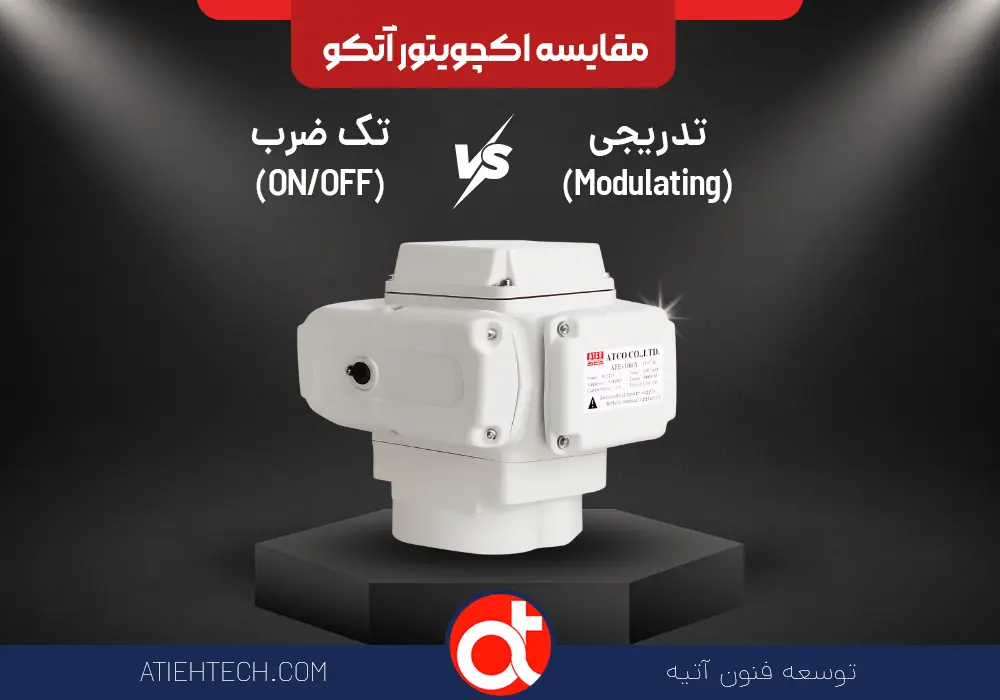
Difference Between Single-Action (ON/OFF) and Modulating ATCO Actuators
Actuators are one of the most important components of control systems in various industries such as oil, gas, petrochemical, power plants, and even building facilities. ATCO, as a reputable brand in the production of electric and pneumatic actuators, offers a variety of products tailored to user needs. Among these products, two widely used types — single-action (ON/OFF) actuators and modulating actuators — have attracted the most attention.
In this article, we will take a detailed look at the differences, advantages, disadvantages, and applications of these two types of ATCO actuators.
What is a Single-Action (ON/OFF) Actuator?
The ON/OFF actuator, also known as single-action, is the simplest and most commonly used type of actuator.
-
Its operation is fully open or fully closed.
-
This actuator has no intermediate positions and only covers two defined states.
-
This type is used in systems that only require turning the fluid flow on or off, or fully opening and closing the valve.
Technical Features of ATCO Single-Action (ON/OFF) Actuators
-
Simple and Robust Design
-
Lower Purchase and Maintenance Cost
-
Long Service Life Due to Fewer Operating Cycles
-
High Operating Speed (the valve fully opens or closes in a few seconds)
What is a Modulating Actuator?
The modulating actuator is a more advanced type of actuator that can control the valve opening angle at various positions.
-
Instead of just two simple states (open/closed), this actuator can adjust the valve opening from zero to one hundred percent.
-
This functionality allows for much higher accuracy in controlling flow rate, pressure, or temperature.
Technical Features of ATCO Modulating Actuators
-
Continuous Control Capability
-
Integration with Industrial Automation Systems (DCS and PLC)
-
Suitable for processes requiring precise flow control
-
Capability to Receive Analog Control Signals (typically 4–20 mA or 0–10 V)
Key Differences Between ON/OFF and Modulating Actuators
Type of Operation
-
ON/OFF: Fully open or fully closed only.
-
Modulating: Gradually adjustable between 0 and 100 percent.
Control Accuracy
-
ON/OFF: Low accuracy, suitable for simple applications.
-
Modulating: High accuracy, suitable for sensitive processes.
Cost
-
ON/OFF: Cheaper and more economical.
-
Modulating: More expensive due to more advanced technology.
Service Life
-
ON/OFF: Long service life due to fewer and simpler operating cycles.
-
Modulating: Higher wear and tear due to continuous movement in various positions.
Applications
-
ON/OFF: Simple pipelines, emergency on/off systems, safety valve control.
-
Modulating: Chemical and petrochemical industries, HVAC systems, power plants, and any application requiring precise flow and pressure control.
| Features | Single-Action (ON/OFF) Actuator | Modulating Actuator |
|---|---|---|
| Type of Operation | Fully open/closed | Gradual control from 0 to 100% |
| Control Accuracy | Low | Very high |
| Cost | Economical | Higher |
| Service Life | Longer | Shorter compared to ON/OFF |
| Applications | Quick/emergency on/off | Process and precise control |
Advantages and Disadvantages of Each Type of Actuator
Advantages and Disadvantages of ATCO ON/OFF Actuators
✅ Affordable price
✅ Easy installation and maintenance
✅ Fast and reliable operation
❌ No precise flow control
❌ Limited use in sensitive processes
Advantages and Disadvantages of ATCO Modulating Actuators
✅ Precise flow and pressure control
✅ Capability to connect to advanced control systems
✅ Increased efficiency in industrial processes
❌ Higher cost
❌ Requires more maintenance
Which ATCO actuator is more suitable for you?
Choosing between ATCO single-action and modulating actuators depends on your type of application:
-
If you only need to turn the flow on or off and control accuracy is not important, the ON/OFF model is the best choice.
-
However, if your process is sensitive and requires precise control of flow, pressure, or temperature, the Modulating model is definitely the better choice.
Key Points When Purchasing an ATCO Actuator
-
Type of Fluid and Operating Conditions (pressure, temperature, corrosiveness)
-
Supply voltage (typically 220V AC or 24V DC)
-
Required valve torque
-
Type of control signal (digital or analog)
-
Safety level and explosion-proof standards (Ex-proof) in hazardous environments
Conclusion
ATCO actuators, with their wide variety and suitable quality, meet a broad range of industrial needs. Choosing between a single-action (ON/OFF) actuator and a modulating actuator depends on factors such as the type of process, required control accuracy, budget, and operating conditions.
If you are looking for an economical, fast, and simple solution, the ON/OFF model is the best choice. However, for sensitive processes requiring precise control, the Modulating model is an ideal option.





Leave a Reply
Want to join the discussion?Feel free to contribute!